TMS Article Issue 001
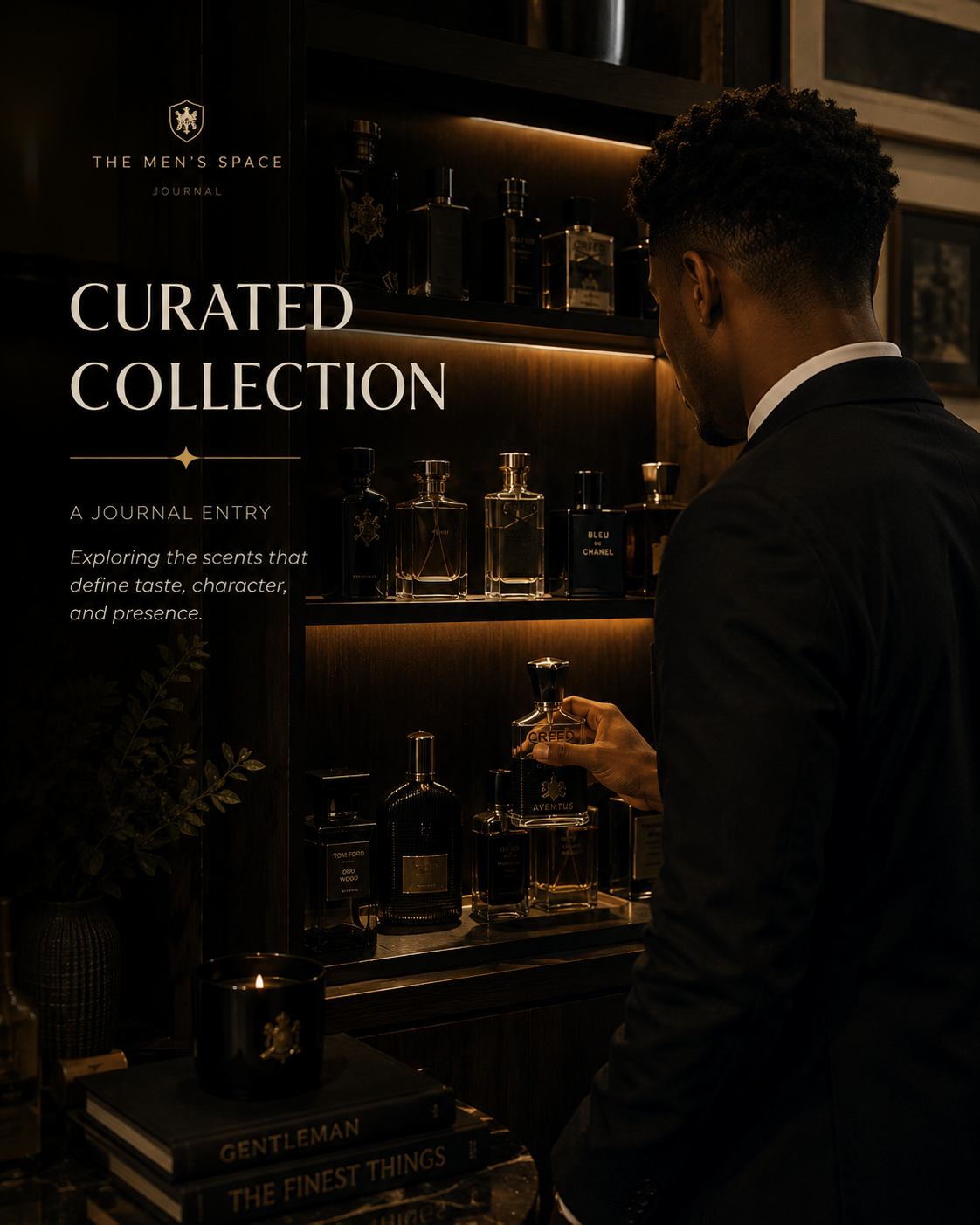
Curated Collection
A Considered Approach to Collecting Fine Fragrances. Written by Theodore Coley
Date Published: June 19, 2026
A Considered Approach to Collecting Fine Fragrances. Written by Theodore Coley
Date Published: June 19, 2026
Anyone can buy fragrances. Very few people build a collection. At some point, every fragrance enthusiast must answer a simple question: are you collecting bottles, or are you curating experiences? A curated collection is not defined by price, hype, or quantity. It is defined by intention. Every bottle should serve a purpose, represent a moment, explore a different scent profile, or say something about your taste. That is what separates a collection from accumulation. Now before I explain what I believe makes a curated collection, let me first explain what it is not.
Let me address the completionists first.
You love a particular brand so much that you feel the need to own every fragrance they release.
Maybe it is Jean Paul Gaultier. Maybe it is Yves Saint Laurent. Whatever the brand may be, your goal is simple: complete the lineup.
Now listen, there is nothing wrong with loving a brand. We all have favourites.
But owning every fragrance from one house does not automatically create a curated collection.
The problem with the completionist mindset is that the journey never truly ends.
Brands constantly release flankers, limited editions, and slight reinterpretations of the same DNA.
Many fragrance houses build their identity around a recognizable formula and simply adjust certain notes depending on the season or occasion.
As a result, your collection may become large, but it often lacks variety.
A curated collection should feel diverse. It should expose you to different moods, textures, accords, and emotions.
If every bottle smells like a variation of the same idea, then you are not curating you are completing.
Now this next section may upset a few people.
If your entire collection consists only of cheap fragrances and dupes, I personally would not consider it a curated collection either.
Before anyone gets defensive, let me be clear: cheapies and dupes absolutely have their place. I own a few myself. Some of them smell incredible, and some even outperform the originals they were inspired by.
But a collection made entirely of dupes lacks exploration.
There are many designer and niche fragrances that helped shape this hobby and push creativity forward.
Some are expensive, yes, but some are genuinely worth experiencing because of the artistry, composition, or uniqueness they bring.
You do not need to spend outrageous amounts of money to have a great collection.
However, saving up for a quality designer or niche fragrance every now and then can add depth and character to your shelf.
A curated collection should balance value with experience.
On the opposite side, we have the fragrance elitists.
“If it isn’t niche, I don’t want it.”
These collectors believe quality can only be measured by price tags and exclusivity.
Ironically, they spend just as much time arguing with dupe collectors as they do enjoying fragrances.
The truth is, fragrance goes far beyond cost.
There are affordable fragrances and clones that smell fantastic.
Some even perform better than the originals they were inspired by.
That is simply reality at this point, whether people want to admit it or not.
Owning only niche fragrances does not automatically make your collection superior.
In fact, many niche-only collectors would benefit from adding a few well-made designers, affordable gems, or Middle Eastern fragrances into their rotation.
A curated collection is not about proving financial status. It is about taste.
Then we have the newly converted enthusiast.
This person has just discovered the fragrance world and suddenly everything smells amazing.
Every week there is a new “must-have” bottle. Every TikTok recommendation feels life-changing.
We have all been there.
Then eventually reality arrives usually in the form of your bank account.
The biggest mistake beginners make is buying every fragrance they enjoy in the moment. The problem is not whether it smells good. The real question is this:
Does it smell good enough to deserve a permanent place on your shelf?
That is the moment a collector begins to mature.
A curated collection requires patience. Sampling becomes more important. Impulse buying becomes less exciting.
You stop chasing every release and begin searching for fragrances that genuinely resonate with you.
"A curated collection is not assembled, but composed built with intention, shaped by individuality, and reflective of your own personal story"
Theodore Coley
Now for the casual fragrance wearer.
Truthfully, you do not need a massive collection to smell great.
Four or five fragrances can realistically cover almost every situation in life:
An optional wildcard fragrance for personal enjoyment.That is enough for most people, and there is nothing wrong with that.
Now we enter hobbyist territory.
At this stage, five bottles were not enough. You now own ten or more fragrances, and your interest in the hobby is becoming serious.
This is where exploration becomes important.
You can no longer keep buying the same type of fragrance repeatedly. If your entire collection is made up of fresh aquatic scents, eventually everything begins to feel redundant.
A curated collection should expose you to different scent profiles:
Even if you think you dislike certain notes, there is probably a perfumer somewhere who has interpreted them in a way you would genuinely love. That is part of the beauty of fragrance. The goal is not to own everything. The goal is to experience enough variety to understand your own taste more deeply.
By now your collection is large, diverse, and carefully selected.
You understand fragrance families. You know what works for your skin.
You know the difference between buying out of excitement and buying with intention.
At this stage, your collection already covers nearly every occasion imaginable. Which means something interesting begins to happen:
You are no longer buying out of need.
You are buying for the love of the art.
This is also the stage where bottle sizes matter less. Not every fragrance deserves 100ml.
Some fragrances are simply experiences worth appreciating without dedicating half your shelf to them.
And because you have smelled so much already, finding something truly unique becomes harder.
This is where private lines, exclusive collections, and lesser-known fragrance houses become interesting. They offer compositions that feel more personal, distinctive, and artistic than what you typically encounter at your local fragrance store.
And finally, the connoisseur.
At this point, there is very little advice left to give you.
You already understand your taste. You have explored countless scent profiles,
discovered hidden gems, made expensive mistakes, and built a collection that reflects years of experience.
There are no strict rules for you anymore.
You simply continue collecting what genuinely moves you.
Because in the end, a curated collection is not about owning the most bottles, the most expensive fragrances, or the rarest names.
It is about identity.
Every fragrance on your shelf should represent something:
Not every fragrance deserves a place in your collection. The ones that remain should say something about who you are.
The conversation doesn't end here. Join The Men's Space to read more journal entries and connect with a community of intentional men. Interested in contributing your own perspective? We'd love to hear from you.
Have A Perspective Worth Sharing ? Contact Us